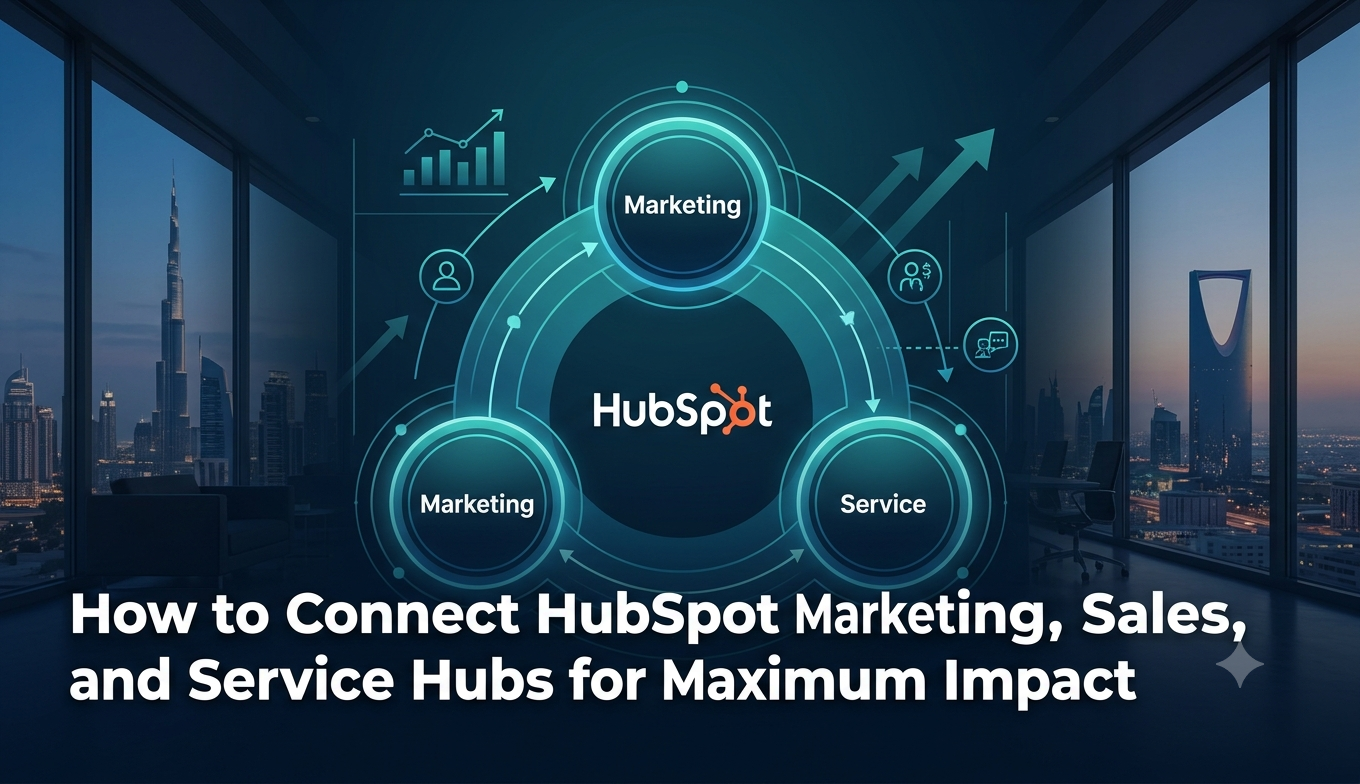
One of the biggest mistakes growing businesses make with HubSpot is treating the Marketing, Sales, and Service Hubs as separate, isolated tools.
When these hubs work in silos, you lose cross-departmental visibility, create friction during customer handoffs, and miss critical opportunities to deliver a seamless customer experience. Marketing spends money driving leads that Sales claims are unqualified, while Service deals with customers whose expectations were misaligned from day one.
The real power of HubSpot lies in Revenue Operations (RevOps)—connecting all three hubs into a single, unified engine. Here is how forward-thinking companies in the MENA region are uniting their hubs in 2026 to drive scale, efficiency, and retention.
1. Establish a Single Source of Truth
Disjointed data is the enemy of growth. Connecting your interactions across all three hubs ensures every team gets a full  view of the customer journey inside one CRM.
- Marketing tracks which campaigns and channels yield high-LTV (Lifetime Value) customers, not just raw lead volume.
- Sales views past support tickets, open service queries, and marketing asset engagement before making a discovery call.
- Service accesses complete deal histories, contract terms, and original pain points to tailor post-sale onboarding.
2. Engineer Frictionless Marketing-to-Sales Handoffs
Lost revenue often happens in the gap between lead generation and sales outreach. Unifying your hubs allows you to automate and standardize lead qualification using custom Lifecycle Stages and Lead Scoring.
- Automated Lifecycle Routing: Trigger real-time notifications to reps the moment a contact transitions from Marketing Qualified Lead (MQL) to Sales Qualified Lead (SQL) based on intent signals.
- Contextual Handoffs: Reps enter conversations with full context—knowing exactly which whitepapers were downloaded, webinars attended, or pricing pages viewed.
3. Close the Loop with Service Feedback
Customer service isn't just a cost center—it's a goldmine for revenue and marketing intelligence. When Service Hub is linked to Marketing and Sales, ticket data directly powers business growth:
- Content Optimization: Support trends highlight common user friction points, providing Marketing with real topics for blog posts, FAQs, and enablement guides.
- Churn Prevention: Open high-priority tickets automatically flag accounts in the Sales pipeline as "At-Risk," preventing reps from attempting ill-timed cross-sell outreach.
- Retention Tracking: Shared CSAT and NPS scores give Sales a clear indicator of when an account is primed for a contract renewal or expansion.
4. Harness HubSpot Breeze AI Across All Hubs
Artificial intelligence is only as good as the underlying data context. By connecting all three hubs, HubSpot Breeze AI accesses unified CRM data to automate intelligence across your operations:
- Predictive Sales Insights: Breeze AI analyzes service interactions and marketing engagement to recommend ideal upsell and cross-sell timing.
- Smarter Service Responses: Customer support agents leverage AI-generated response drafts grounded in your existing marketing assets and knowledge base.
- Accurate Revenue Attribution: AI-driven analytics give marketers real-time visibility into which multi-touch campaigns directly generate closed-won deals.
5. Build Unified RevOps Reporting & Dashboards
To make strategic decisions, leadership needs a single dashboard that tracks the end-to-end customer lifecycle rather than fragmented departmental reports.
|
Metric Type |
Unified Hub Advantage |
|
Attribution |
Tracks total revenue generated per marketing campaign and channel. |
|
Customer Health |
Combines product usage, support tickets, and engagement into real-time health scores. |
|
Forecasting |
Improves pipeline predictability by factoring in churn risk from active service tickets. |
3 Pitfalls to Avoid When Unifying Your Hubs
Connecting your hubs is an operational shift. Avoid these common traps to ensure smooth adoption:
- Over-automating without clear rules: Automating lead handoffs before defining what constitutes an SQL will only send low-quality leads to sales faster.
- Ignoring data hygiene: Duplicate contacts and inconsistent field properties will degrade Breeze AI recommendations and reporting accuracy.
- Skipping cross-departmental training: Ensure reps across Sales and Service know how to read each other’s timeline activities so the shared data actually gets used.
Quick Implementation Checklist
Ready to align your operations? Use this roadmap to connect your hubs:
- Audit current custom properties across Marketing, Sales, and Service.
- Standardize lifecycle stage definitions with sales and marketing leadership.
- Configure lead scoring based on content engagement and demographic fit.
- Set up automated deal and ticket creation rules for seamless handoffs.
- Create a central executive dashboard covering attribution, pipeline health, and CSAT.
The Bottom Line
Connecting your Marketing, Sales, and Service Hubs isn’t an overhaul that takes months of operational downtime. With an intentional RevOps strategy, you can turn disparate tools into a unified customer platform that scales your revenue predictably.
Ready to Connect Your Hubs for Maximum Impact?
If your teams are working in silos or you want to unlock the full potential of your HubSpot investment, ConnectIn can help you streamline your setup, automate your workflows, and align your operations.